Showing posts with label Bowes Museum. Show all posts

Feast Your Eyes

A sugar paste church based on one originally made for Queen Victoria;s ball supper in Hatfield House in 1845
I spent a great deal of time this summer working on Feast Your Eyes, the Fashion of Food in Art, an exhibition at the marvellous Bowes Museum in Barnard Castle in County Durham. If you do not know this extraordinary place, which is one of the best kept museum secrets in Britain, make an effort and visit it. You will return again and again. It is a world class museum in the  beautiful market town of Barnard Castle in Northern England. It is on a South Kensington scale. It is the third exhibition there that I have worked on over the years. I was also the guest curator in 2003 of a spectacular show called Royal Sugar Sculpture and worked with decorative arts curator Howard Coutts in 1994 on the seminal food history exhibition The Tempting Table. In the last twenty years, the Bowes Museum and Fairfax House in York have led the field in food history exhibitions. What we did in those early shows set a worldwide trend among decorative arts curators. This is why I keep getting asked by institutions like the Met in NYC, MFA in Houston and other major American museums to work with them on this fascinating area. I am writing this in my hotel room in Minneapolis, where I will start setting up a lovely exhibition on dining in renaissance England entitled Supper with Shakespeare which opens at Minneapolis Institute of Arts on December 13th. It is going to be spectacular. My next post will be about the show.

It has been a great deal of fun setting up Feast Your Eyes with the Bowes Museum team. And what a selection of paintings relating to food and other works it is, the majority from the Bowes collection. A stunning Peter Aertsen of market traders washing vegetables was specially restored for the show. You can see videos of the actual restoration on the Bowes Museum blog, but the crown must go to the 'breakfast' table still life by Jacob van Hulsdonk, which is a striking example of the work of this early seventeenth century Antwerp school artist. He was a contemporary of Osias Beert and the wonderful Clara Peeters, two other important artists working in the city who specialised in painting dining settings of this kind. His work deserves to be better known. He painted a very similar, though less ambitious study which can be seen in the Rijksmuseum Twenthe in Enschede in Holland. Both celebrate simple merchant class meals, a plate of trotters, some rye bread and a glass of weissbier. They must also be among the earliest European paintings which depict Chinese porcelain being used on a table. The same knife with a decorative handle appears in both pictures. Was this a studio object? Or is it the actual knife with which the artist ate his food. I have noticed that other early Netherlandish masters, such as Clara Peeters and Pieter Claez repeatedly depict the same knife in their works too. Was it a kind of signature? I have said this before, but during this period you carried your eating knife around with you and it was frequently one of the more valuable objects you owned, just as much a treasured item of jewellery and not just an implement to spear your meat on. You flaunted it, just as some people nowadays flash their iphones and blackberries, (though I hope you don't do this at the dinner table).

Jacob van Hulsdonk, Still life. Antwerp. 1615. Courtesy of the Bowes Museum.
Jacob van Hulsdonk, Still life. Antwerp. 1615. Courtesy of Rijksmuseum Twenthe.
Josephine Bowes, Bodegón. Oil on Canvas. Photo Syd Neville - courtesy of Bowes Museum
In a similar vein is a much later food still life by the co-founder of the museum Josephine Bowes, actress, art collector and a fine painter herself. Since the gadrooned copper cauldron is still in her collection, with some help from Sue Hall and John Hudson, we were able to recreate the table top arrangement of objects which Josephine worked from - still life imitating art if you like!

However, my main task was to have a go at bringing to life a tiny little watercolour of a ball supper in the collection of Hatfield House. This anonymous and unassuming work depicts the marble hall at Hatfield set up with trestle tables covered with food and floral arrangements

It depicts an actual event at Hatfield House attended by Queen Victoria and Prince Albert in 1845. It is one of those rare things, a painting of food being consumed in an English setting. We printed an enlargement of the painting so it completely covered a wall and then set up a table in front of this covered in the typical delights of a high status ball supper. The painting shows a pie in the form of a castle emblazoned with Victoria and Albert's initials and also a sugar paste church, which was probably made by a London confectioner especially brought in for the occasion called Ferdinand. I made both for my recreated table. The Hatfield archives have a very large and particularly detailed account book with entries made at the time of this visit listing the extraordinary amounts of provisions and beverages consumed during the event. While the aristocratic guests enjoyed their supper, the estate workers and poor of Hatfield were treated at Lord Salisbury's expense to a huge ox roasted on a spit in front of the house.

The Hatfield House ball supper. Photo Syd Neville - courtesy of Bowes Museum

A section of the exhibition relating to tea and sugar consumption - Photo Syd Neville - courtesy of Bowes Museum

General view of exhibition. Photo Syd Neville - courtesy of Bowes Museum 
A jelly depicting the early Queen Victoria with its mould made by Ivan at a demonstration on Victorian food he did at the opening of the exhibition.

Feast Your Eyes is on until Sunday 6th January. For more details go to the Bowes Museum website. 
I an giving a lecture there on the 4th January called - 

The Twelve Days of Christmas
4 January, 2.15, £6.00
Join critically acclaimed food historian Ivan Day for this animated & energetic lecture and food demonstration to complement the current exhibition, Feast Your Eyes: The Fashion of Food in Art. Booking required on 01833 690606.

Don't miss it!

Edible Artistry

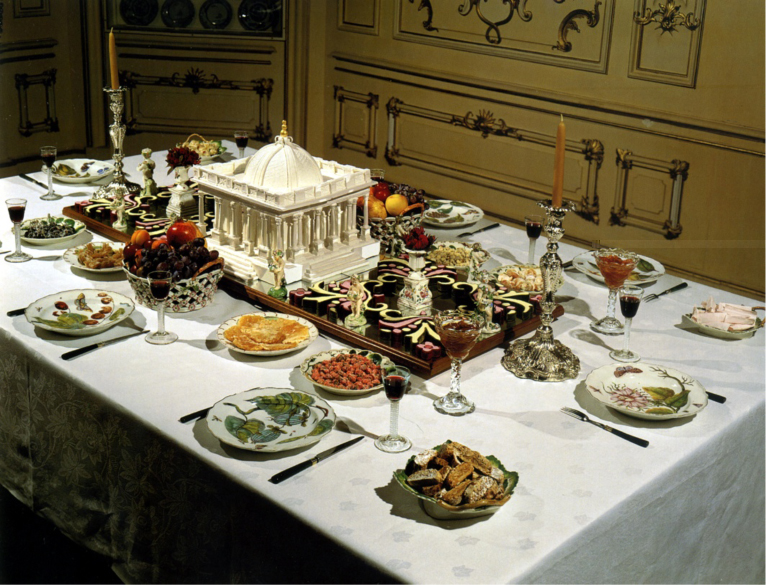
An eighteenth century rococo dessert I created at the Bowes Museum in 1994 using a Chelsea botanical dessert service, Derby fruit baskets and figures. The sugar paste palace is surrounded by parterres filled with coloured sugar sands (sables d'office). All the confectionery items are made from eighteenth century recipes. The panelling in the room was taken from Chesterfield House, which had the earliest rococo interior in England.

I have always been fascinated by the aesthetics of food and how it relates to prevailing trends in the mainstream visual arts of a given period. Dine in a good contemporary restaurant these days and your various menu choices will almost certainly be arranged rakishly on the plate with a garniture of gestural smears, dustings and drizzles. The prevailing aesthetic seems to be a culinary form of abstract impressionism.  I had a nice lunch a couple of days ago in a promising new local brasserie. My starter was not quite an Arshile Gorky, my main course definitely a Willem de Kooning and my dessert a Mark Rothko, though painted crimson in coulis, sorbet and wild strawberry tuile rather than acrylics. But it must be said that what might seem like a cutting edge arrangement of food sitting on a dinner plate today will in a few years almost certainly look dated. 'Did we really eat like that?' you will probably ask, 'And did we really call it molecular gastronomy? How embarrassing!' Food is as subject to the vagaries of fashion as clothes, popular music and most other cultural manifestations.

In the past, the prevailing styles of decorative art not only dictated the form and ornamentation, lets say, of a silver or porcelain dinner service, but frequently also the appearance of the food that was served on it. Some high status dishes in the medieval and early modern periods were not merely decorative, but adorned with images of allegorical, heraldic or religious significance. Witness the sixteenth century Portuguese almond paste mould below, carved with an image of Orpheus playing music to the beasts and birds - or the early modern French multi-purpose food mould with hunting scenes and coats of arms.


Photo: courtesy of Errol Manners

In the seventeenth and early eighteenth century, pies with incredible baroque pastry decorations similar to those on plasterwork and woodcarving were a common element at important feasts. The pastry cooks who made these extraordinary food items possessed skills which were frequently as well developed as those of artists who worked in more conventional media.


An eighteenth century dessert like the one illustrated at the beginning of this post might be surrounded with ice creams, flummeries and blancmanges moulded in the form of obelisks, tromp l'oeil baskets of fruit and other spectacular delights. The smears and drizzles of twenty-first century restaurant food, though attractive to us, would have seemed puzzling to an eighteenth century diner who expected a dessert dish to look more like this - 

Flummery made from a Wedgewood creamware mould c.1790

When the manufacture of food moulds started on an industrial scale in the nineteenth century, it was not just the wealthy who enjoyed artistically wrought food. Moulded dishes both savoury and sweet became fashionable at most levels of society. In the early Victorian period some diners even celebrated the accession of their young monarch with a jelly moulded in the form of her profile, rather like that on the celebrated penny black stamp issued in 1840.


Nineteenth century English food was certainly intricate and highly decorated, as appearance was just as important as taste. 

The extraordinary Victorian Belgrave jelly with its internal spirals of cream 


Watch the above video of the remarkable Belgrave Jelly in motion


A basket of flowers - this time made in fruit-flavoured water ices rather than flummery 
By the 1880s this highly ornamental style of cuisine was being practiced by home cooks as well as professionals. Cookery schools like that of Mrs Agnes B. Marshall in Mortimer Street, London were not only teaching housewives and domestic cooks how to make these spectacular dishes, but also sold you the necessary moulds, cutters and other equipment.


So if you wanted to make the bundle of asparagus made of water ice like that above, you could not only buy the necessary moulds from Mrs Marshall's shop, but also learn the very tricky art of using them in one of her cookery lessons. By the way, all the food depicted in this post was made by me or by my students in my cookery classes. I can teach you how to make technically challenging dishes like this using original period equipment. So have a look at the courses page on my website. 

Mrs Marshall with her cookery class. Her apron and cuffs were as fancy as her culinary creations

I have said that food presentation has always been subject to the influence of fashion, but it can also reflect more important issues, such as those of sensibility. For instance, the four ways of dishing up larks below, from Mrs Marshall’s The Cookery Book (London: 1885) may have looked appetizing and even charming to a Victorian diner, but a restaurant serving these little guys today would probably get a brick thrown through its windows. These steel engravings do illustrate just how food ornamentation has dramatically changed.


The manner in which the food was actually served at table also had a profound effect on the style of presentation. Nowadays, restaurant food is delivered to each diner in the form of an individual plated-up serving, nicely manicured and tweaked by the chef. Mrs Marshall’s food was not designed for restaurants, but for serving in homes. Her dishes were cut up and served out at the table, so the aim was to have larger, often striking arrangements from which portions would be cut and shared out. Some of these dishes, especially the entrées and entremets, would look spectacular when first delivered to the table, but once attacked with a knife, the result would often be a mess. The salmon dish below, which I made from a recipe in Jules Gouffe, The Royal Cookery Book (London: 1868) with its ermine-like contised fillets of sole, truffled quenelles of whiting, whole truffles and crayfish looks far too amazing to eat! Such a pity to cut it all up and destroy the effect.


Salmon à la Chambord 1868

Mrs Marshall died in 1905. Her fussy, highly ornamental food represented a style of dining that went back to the Second Empire and eventually to Carême. It was enjoying its final sunset in those years leading up to the Great War and she was one of its last advocates. A couple of years after her death Picasso painted Les Demoisseles d'Avignon and the world shifted dramatically on its aesthetic axis. Modernity kicked in and the presentation of food was inevitably influenced by the new zeitgeist. Minimalism in food presentation eventually triumphed over the highly embellished and figuratively moulded creations of the nineteenth century with their fussy garnitures. Skilled kitchen workers and servants who could work in this demanding labour-intensive genre also became scarce as a result of the Great War. In addition a stoicism in food matters set in through the influence of military culture and the privations of war. Fussy Victorian food started to look old fashioned and wasteful. Time-consuming dishes which required specialist moulds and a kitchen full of skilled servants lost their appeal. 

One highly decorative and technically demanding dish, which to me represents this lost culinary world, is the chartreuse. Antonin Carême offered recipes and illustrations of these spectacular creations in some of his books, and most other nineteenth century cookery writers follow suit. Originally they were savoury dishes in which vegetables cut into geometric shapes were used to line charlotte moulds. But there were sweet versions too. Here is one which I made a couple of days ago from Mrs Marshall's  Cookery Book (London: 1885) called a Chartreuse of Peaches à la Royale.

Chartreuse à la Royale, a fancy late Victorian entremet invented by the food writer Agnes B. Marshall


Marshall was a clever and very entrepreneurial bunny. You will notice that in her recipe the bavaroise filling for the chartreuse is the same as that used in another of her dishes called Almond Charlotte à la Beatrice. Well this recipe is not in the same book. To get it you would have to buy her Larger Book of Recipes! She tells us to divide the bavaroise into three portions and colour them separately with her patent food colours of course- Marshall's carmine and vegetable green, which you had to buy from her shop.

Cutters like these were essential for making chartreuse
The finished chartreuse with its garniture and hatalet

A plain charlotte mould was the other requirement

When sliced, the bavaroise is revealed in three pastel shades
Apart from lunatics like me, very few cooks make chartreuses nowadays. You need the patience of Job, a fine sense of detail and an expensive collection of antique culinary equipment. If you do want to have a bash, here is a recipe from 1932 (Anon. The Illustrated Cookery Book) for an easy one and probably the last surviving member of its race - a banana chartreuse. Just go easy on the gelatine to get the softest set and mouthfeel and you will have made a spectacular and delicious dish.

Banana chartreuse 1932 - no chefy drizzles or smears here!

Banana Chartreuse 

1 pint of cream; 2 oz. of sugar ; ½ oz. of gelatine ; 1 gill of clear 
jelly; ½ pint of banana purée; 1 gill of water; 1 oz. of pistachio
 nuts; 2 bananas.


A plain Charlotte mould should be lined with jelly, the 2 bananas 
cut into thin rounds, and the bottom of the mould lined with these
 rounds. Chop and blanch the pistachio nuts finely and sprinkle the
 spaces between the rounds with the nuts. Pour a little jelly over the 
decorations very carefully with a spoon and let this set, then decorate
 the sides of the moulds with the banana rounds and pistachio nuts in 
any pattern desired. Set the decorations with a little clear jelly. Rub sufficient bananas through a hair sieve to make half a pint of puree.
Dissolve the gelatine and the sugar in the water, and strain them 
into the purée. Whip the cream and add lightly. When cold, fill 
the prepared mould with the mixture. Leave it in a cold place or
 on ice until set. Turn out the mould on to a glass or china dish and 
garnish with a little chopped jelly.


A gill is 5 fluid ounces

As well as sweet chartreuses, there were also many savoury ones like these below.


This is a vegetable chartreuse made with discs of carrot and cucumber embedded in a partridge forcemeat

Sometimes a chartreuse was made in a ring mould. The hollow in this one is filled with a fresh pea purée around which the  grilled lamb cutlets have been arranged to form what was known as a 'turban'
A steel engraving from Urbain Dubois, Cosmopolitan Cookery. (London: 1870. Showing how a vegetable chartreuse was used to create a turban, in this case Fillets of Pigeons à la chartreuse.


Listen to BBC Radio 4 programme on food and art - Architects of Taste - available until 22 March 2012. Presented by Ian Kelly with contributions by Roy Strong, Anne Willan, Ferran Adria, Jane Asher, Ruth Cowan and Ivan Day. Some of Ivan's contributions to this programme were chosen by Simon Parkes for BBC Radio 4's prestigious Pick of the Week programme. 

Our Location

 
Copyright © 2011. my-kitchen-adventures - All Rights Reserved
Proudly powered by Blogger